Venezuelan opposition leader María Corina Machado reported that her colleague, Juan Pablo Guanipa, has been kidnapped mere hours after his release from detention.
The Nobel Peace Prize winner announced on social media that Guanipa, who heads the Justice First party, was forcibly taken from the Los Chorros neighborhood in Caracas.
Heavily armed men dressed in civilian clothes arrived in four vehicles and took him away by force, Machado stated in a message early Monday.
Guanipa, who previously served as vice-president of the National Assembly, spent eight months in prison. His release occurred amidst a backdrop of political turbulence following the U.S. seizure of Venezuela's former President Nicolás Maduro in January.
The Justice First party alleged that he was kidnapped by individuals representing the repressive forces of the dictatorship during a movement between locations.
Eyewitnesses reported that weapons were drawn as Guanipa was forcibly loaded into a vehicle. The party has publicly accused Delcy Rodríguez, Jorge Rodríguez, and Diosdado Cabello, prominent figures in the Venezuelan government, of responsibility for Guanipa's safety.
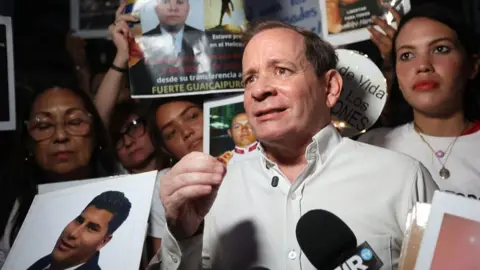
In a dramatic plea, Guanipa's son Ramón shared on social media, expressing relief and joy at his father's earlier release but later demanded immediate proof of his safety, following the kidnapping.
Ramón stated, I hold the regime responsible for anything that happens to my father. Enough of this repression, emphasizing the challenging landscape for dissent in Venezuela.
Guanipa was among at least 30 individuals freed on the same day, as reported by Foro Penal, an organization dedicated to assisting political prisoners in the nation.
A recent governor of the Zulia region (elected in 2017), he had been unable to assume office after declining to swear allegiance to Maduro's National Constituent Assembly.
After being accused of terrorism and treason linked to the upcoming 2024 elections, Guanipa had been in hiding before being captured by the Venezuelan security forces in May 2025.
Opposition and human rights organizations assert that under Maduro's government, detaining political opponents has long been a strategy to stifle dissent and silence critics.