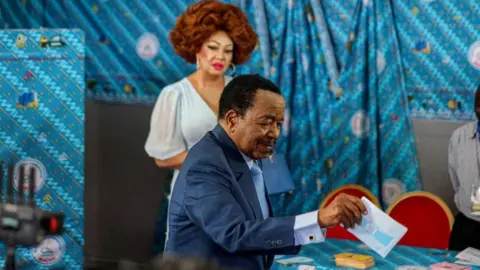
Cameroon's 92-year-old president has won a controversial eighth term, in a fiercely disputed election.
Paul Biya, who is the world's oldest head of state, won 53.7% of the vote, compared to the 35.2% of opposition leader Issa Tchiroma Bakary, the Constitutional Council declared.
Before the announcement, Tchiroma Bakary - a former Biya ally - insisted he had won the election, but the ruling Cameroon People's Democratic Movement (CPDM) dismissed his claim.
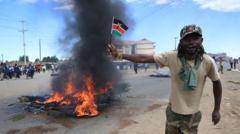
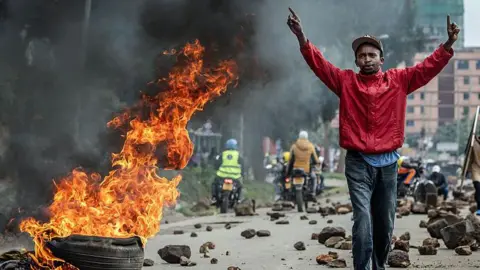
The election, held on 12 October, has been marred with deadly violence, and in recent days, hundreds of Tchiroma Bakary's supporters have defied protest bans in several cities, and clashed with security forces.
On Sunday, at least four people were killed during protests in Cameroon's economic capital of Douala.
The regional governor, Samuel Dieudonné Diboua, said police posts had come under attack and security forces had defended themselves.
The unrest continued on Monday, when a number of people were shot dead near Tchiroma Bakary's residence in the city of Garoua, a local journalist on the scene told the BBC.
Around the same time, the opposition leader wrote on Facebook that shots were being fired at civilians gathered outside his home. He later claimed that snipers had been stationed at the house across from his, and were firing at point-blank range at the people.
The authorities have not yet commented on these reports.
Protesters were denouncing what they said was a plan by the ruling CPDM to steal the victory from Tchiroma Bakary.
The situation is so tense in the capital, Yaoundé, that almost all shops and schools have remained closed, while most civil servants and office workers stayed home.
In total, 10 candidates were in the running for the presidential office, including former Prime Minister Bello Bouba Maigari.
Voter turnout was 58%.
At least 10 petitions alleging electoral malpractice have been rejected by the Constitutional Council.
Residents in Yaoundé have been voicing their opinions on Biya's controversial victory.
We are at the beginning of another nightmare, Amungwa Nicodemus told the BBC.
The economy is declining, corruption is endemic, a lot of things are going wrong.
President Biya, who came to power in 1982, has yet to publicly address Cameroonians after his re-election on Monday, but the governing party has hailed his victory under the sign of greatness and hope in online posts.
While his leadership has been praised for the expansion of schools and public universities, his tenure has also faced criticisms, including a violent separatist insurgency and high youth unemployment rates.
Biya's government now faces a critical juncture as the nation grapples with political unrest and citizens question the legitimacy of the election results.