In brief
Amidst Syria's changing political landscape, Abu Mohammed al-Jawlani has rebranded from a jihadist figure into a capable politician, striving to gain legitimacy for his group amidst ongoing protests and geopolitical pressures.
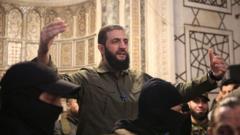
Abu Mohammed al-Jawlani, who has long been associated with a jihadist past, is now embracing a new identity as Ahmed al-Sharaa, demonstrating a notable shift in his public persona. This transformation comes as his group, Hayat Tahrir al-Sham (HTS), spearheads significant operations in Syria, recently capturing the capital, Damascus. Jawlani’s evolution has not been a sudden occurrence but the result of a gradual effort to redefine his role within the rapidly changing context of the Syrian conflict. Once commanding attention in traditional militant garb, he has now adapted to a more conventional military appearance, aligning with his leadership during the recent offensive.Born in 1982 in Saudi Arabia, Jawlani's journey into extremism began during the Iraq War when he became involved with al-Qaeda and later established the al-Nusra Front in Syria. His relationship with the Islamic State (IS) was complex; he initially distanced al-Nusra from IS's brutal tactics, which resulted in a split and his subsequent alliance with al-Qaeda.In a strategic pivot in 2016, Jawlani dissolved ties with al-Qaeda, rebranding al-Nusra Front as Jabhat Fatah al-Sham, and later as HTS. This shift aimed to solidify his grip over northern Syria while attempting to appeal to a local populace wary of extremist affiliations. HTS, under Jawlani's leadership, has established a governance structure in Idlib, creating the Syrian Salvation Government to manage essential services, showcasing its ability to rule effectively. This governmental façade aims to garner civilian support while mitigating concerns over militant control in the region.Despite his efforts for political legitimacy, Jawlani has faced increasing dissent and protests, especially against accusations of authoritarian rule. Attempts to reform the HTS's image have included the disbandment of a controversial security force and the establishment of a grievance department where locals can report abuse.The recent offensive against government forces has temporarily silenced critics, enhancing Jawlani’s position as he and the SG project promises of security and stability to both the local population and international observers. While he aims to portray HTS as a balancing force in a turbulent environment, whispers of his jihadist roots continue to echo in the international media. While some factions within Syria see his leadership as a liability, HTS's rapid advances against government forces suggest a potential shift in the political landscape, possibly signaling a transition away from rigid global jihadism toward a more localized, pragmatic approach to governance. Jawlani's radical transformation may inspire similar groups to adapt, marking a pivotal moment in Syria's enduring conflict.