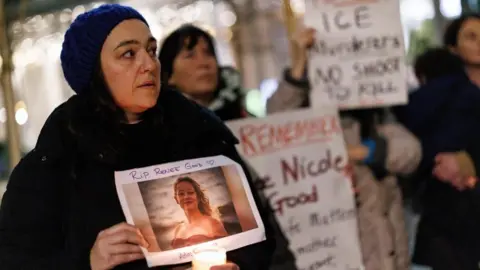
U.S. investigators will face a host of complex questions in determining whether the recent fatal shooting of Renee Good by a federal agent in Minneapolis was justified. This incident has sparked nationwide protests and contrasting narratives from local and federal officials.
Multiple videos show ICE agent Jonathan Ross firing at and killing 37-year-old Good while she was inside her car. President Trump characterized Good as attempting to run over the agent, whereas state officials contended she was merely trying to leave the scene. Former law enforcement officials suggested that the agent might have perceived himself to be in danger, lending potential justification to his use of deadly force.
However, the immediate support from officials in Trump’s administration for Ross raises concerns regarding the integrity of the investigation. Former FBI special agent Robert D'Amico pointed out that strong public declarations of justification can create biases that complicate fact-finding efforts.
Videos showing the confrontation depict ICE agents approaching Good’s vehicle and attempting to remove her from the car. The situation escalated as Ross, also filming, fired shots as the car moved toward him, leading to differing interpretations of the agent's perceived threat level.
The investigation will involve evaluating Ross’s actions against Department of Homeland Security (DHS) policies regarding the use of deadly force. Significantly, policies stipulate that agents may fire at moving vehicles only if there is an immediate threat to life or severe bodily harm. The actions Ross took when firing multiple rounds at Good, especially after she had begun to pull away, will also come under scrutiny.
Federal investigators are tasked with not just analyzing video evidence but also reconstructing the scene and considering witness accounts and the contextual background of the incident. Minnesota officials express concern that a solely federal investigation may be biased, necessitating their own review.
This case highlights broader tensions surrounding law enforcement practices, the impact of political narratives, and the complexities involved in assessing justification in incidents involving deadly force.