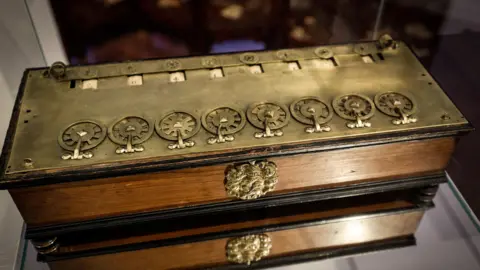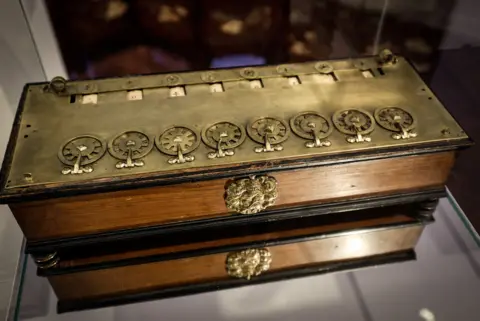
One of the world's first calculating machines will not go to auction as scheduled, after a Paris court provisionally blocked the historic item from being exported. Auction house Christie's has confirmed it will not proceed with a bid for the machine La Pascaline, developed by the French mathematician Blaise Pascal in 1642.
Valuations suggested the machine could fetch €2 to 3m (£1.77m to £2.65m). Christie's called it the most important scientific instrument ever offered at auction. Scientists and researchers made a legal appeal to grant heritage protections to this historic instrument, arguing it should be classified as a national treasure.
Pascal was just 19 years old when he developed the earliest version of a calculator, and there are only nine of these machines still in existence. It is the first attempt in history to substitute the human mind with a machine, states the official collection description.
The invention represents a breakthrough that holds particular relevance today. La Pascaline was exhibited at Christie's venues in New York and Hong Kong throughout the year and was included in an auction of the library of the late Catalonia collector Léon Parcé, featuring Pascal's philosophical piece Pensées and the first printed version of Pascal's wager.
On Wednesday, a Paris administrative court temporarily blocked an earlier export authorization provided by France's culture minister in May. The judge indicated there were serious doubts regarding the legality of the certificate allowing exportation. A Christie's spokesperson announced the suspension of the sale in response to the court's provisional decision.
The court emphasized that La Pascaline's historical and scientific value could warrant classification as a national treasure, which would guarantee protections under France's heritage code. The French heritage group, Association Sites & Monuments, which was an applicant in this case, welcomed the court's decision.