In brief
This article delves into the festive atmosphere of Birmingham's Frankfurt Christmas Market, hailed as 'the largest authentic German Christmas market' outside Germany. Featuring insights from German students and market organizers, it examines the similarities and differences between Birmingham's market and those traditionally found in Germany. The narrative underscores the growing popularity of Christmas markets across the UK, while also capturing the essence of the authentic German experience found in Berlin.
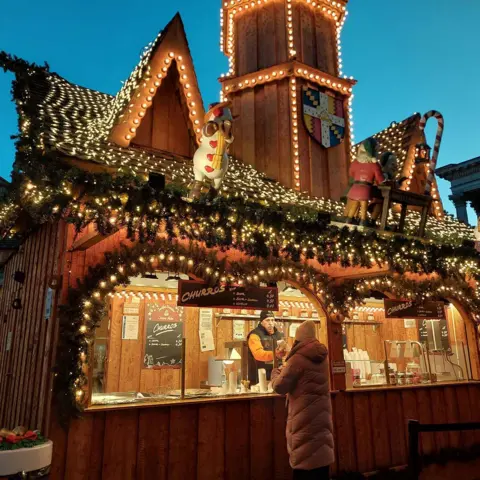
Wooden huts are glittering with golden fairylights as groups of friends gather in woolly hats, warming their hands on mugs of mulled wine.
Signs written in German are dotted about - Glühwein (mulled wine), Bratwurst (grilled sausage), Kinderpunsch (non-alcoholic punch).
This isn't Germany - it's Birmingham's Frankfurt Christmas Market. Organisers say it's the largest authentic German Christmas market outside the country and Austria.
Christmas markets are thought to have originated in Germany in the 14th Century, and its markets have long been admired since. But how close are the ones in the UK to that supposed traditional, real thing?
BBC News visited some to find out - and perhaps provide some inspiration for your next festive visit.
A taste of Germany... in Birmingham?
On a cold Thursday afternoon in Birmingham, we have just met Nina Adler and Till Rampe, 27-year-old German students studying for PhDs in the UK's second city.
As we walk around the Christmas market, which snakes through streets close to Birmingham New Street railway station, they're reminded of home.
They point to the wooden huts, food and drink, and the handicrafts as positive signs this is close to the traditional ideal. The chocolate-coated marshmallows at one stall impress Till, who is from a town near Frankfurt. I could swear they are from my hometown, he says.
But other aspects of Birmingham's market are further removed from the German way - like the beer. People are just connecting Germany with beer, Nina, from Berlin, says. In Germany usually you drink mulled wine. This is very typical.
And as for the pop tunes blaring out of the speakers in Birmingham - like The Power of Love - you probably wouldn't hear that at markets in Germany - rather it would be Christmas music and carols, she says.
Also visiting the market with us is Katharina Karcher, an academic at the University of Birmingham. Her verdict? It's super authentic.
Having been set up in 1997 and running annually since 2001, the Birmingham market is organised by Kurt Stroscher, who is also director of Frankfurt's Christmas market. He uses only wooden stalls and atmospheric white lights that don't blink, with the stalls built in Germany and food and drink imported from there.
It's mostly a thumbs-up for Birmingham's Christmas market when it comes to authenticity, then - but how does it compare to one in Germany?
Our visit to a Christmas market in Berlin
While many Christmas markets in the UK have been running for a couple of weeks now, in Germany they have only just opened, as is tradition, on 24 November.
Most German towns and cities have a Christmas market, with Dresden, Nuremberg and Cologne among the most famous.
These markets hold huge symbolic meaning to Germans, says Dr Karcher, who's from near Frankfurt. Along with a religious undertone, they are what get people through the dark time, she explains.
Some 800 miles away from Birmingham, the city of Berlin is home to more than 70 different, small Christmas markets. In Charlottenburg Palace in the west of the German capital, the market is bustling and filled with people of all ages when we visit on a Tuesday night.
The smell of roasted almonds, caramelised apples, chocolate-coated fruit, mulled wine and grilled sausages fills the air, as Christmas carols are performed live on a stage and children enjoy a small, sparkling Ferris wheel.
The 17th Century Baroque Charlottenburg Palace is illuminated in different colours, with falling snowflakes projected onto its facade and wooden stalls in front.
So what exactly makes a traditional German Christmas market?
Typically, they may have (as this one in Berlin does):
- Large tents housing entire restaurants or bars
- Stalls selling a range of handmade gifts, including woolly hats, gloves, scarves, jewellery, handmade candles, wooden nutcrackers and other arts and crafts
- Traditional German foods like Lebkuchen (the German version of gingerbread), many kinds of sausages including Bratwurst, cheeses, hearty dishes like Langos or goulash, and Spätzle
- Mulled wine for those who drink alcohol, not so much beer
- A location in a square in the Altstadt, the old part of a town
To Magrita, 66, who is enjoying a mulled wine with her husband Dietmar, 69, German Christmas markets are characterised by their unique atmosphere: The colourful lights and Christmas decorations make it so special.
Dietmar explains how Christmas markets are not the same as other markets labelled as 'Winter Market' or 'Winter Wonderland,' because of the fairytale-like feeling you only get at an authentic Christmas market.
However, Anna and Karolina, both 19, express their nostalgia for the food and drink, stating their core belief in what makes a Christmas market authentic.
Other Christmas markets in the UK
Back in the UK, while Birmingham can boast about its markets authenticity, what of other locations in the UK?
Christmas markets have become a staple of many UK cities - Manchester, Leeds, Bath, Edinburgh and Newcastle among them. Smaller markets, typically in historic settings, are also proving popular. Since 2023, Lincoln Christmas market has been closed because of overcrowding concerns.
Meanwhile, the Kingston upon Thames market, with its open mic nights and diverse food offerings, illustrates a somewhat different approach, prioritising general festivity over the German theme.
Though visitors appreciated the ambiance, opinions varied on their sincerity as traditional Christmas markets, primarily when compared to Birmingham's more authentic experience.
In summary, while Birmingham's market stands out for its genuine alignment with traditional German practices, the growing proliferation of Christmas markets across the UK showcases a blend of cultural influences that represent the festive spirit in diverse ways.