In brief
Amid escalating geopolitical tensions, Russia's narrative surrounding World War II is shifting from a focus on the Holocaust towards highlighting the suffering of Soviet citizens. President Putin's recent memorial unveiling symbolizes this change, diminishing the individual tragedy of Jewish genocide while promoting a collective memory of victimhood.
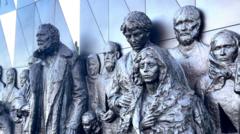
On the outskirts of St. Petersburg, a towering memorial dedicated to "Soviet civilians who fell victim to the Nazi genocide" has ignited discussions about the portrayal of historical narratives surrounding World War II. Unveiled by President Vladimir Putin last year, this site pays homage not just to the Holocaust but broadens the lens to include all Soviet suffering during the conflict, including the staggering loss of over 27 million citizens.The memorial features a poignant statue of a mother with her children and includes an eternal flame burning in memory of various Nazi death camps like Auschwitz. However, unlike Holocaust memorials that often highlight the systematic eradication of Jews, this site emphasizes a shared Soviet experience, further underscoring a trend seen in Russia's current political dialogue.On January 27, a date marking the liberation of Auschwitz by Soviet forces, Putin stressed the idea of the "genocide of the Soviet people," diverging from previous acknowledgments of the Holocaust's unique horror. Despite his statements recognizing the Holocaust's impact on Jewish communities, critics argue that Russian authorities are prioritizing a narrative that positions Russians purely as victims of Western aggression.This narrative shift has not gone unnoticed internationally. Israeli Ambassador to Moscow, Simone Halperin, remarks on the importance of acknowledging the Holocaust as a deliberate attempt to annihilate a race, underscoring that this historical distinction should not be overshadowed by broader victimization claims. Historian Konstantin Pakhaliuk points out that, especially since the onset of the conflict in Ukraine, the portrayal of Russians as historical victims has become a politically charged theme.In contrast to the narratives evolving within Russia, the global community, especially in Europe, is adopting a stance that reflects a clearer demarcation between the Holocaust and other wartime atrocities. Notably, Russia has been excluded from commemorative events in Poland for the 80th anniversary of the Auschwitz liberation – a move that has been criticized by some Russian Jewish leaders who emphasize the collective struggle against fascism during WWII.As civil society groups and Jewish organizations rally to preserve the memory of past atrocities, there is growing concern over the rise of right-wing ideologies and Holocaust denial, necessitating an unflinching remembrance of the events of over eight decades ago. According to Anna Bokshitskaya of the Russian Jewish Congress, the importance of educating the public about these historical truths is more crucial than ever to prevent the repetition of history's darkest chapters.