In brief
Marian Turski survived the horrors of the Holocaust and became a renowned historian and journalist, advocating against indifference to prevent history from repeating itself. His impactful words and life story serve as a lesson for future generations, transcending borders to raise awareness about antisemitism and human rights.
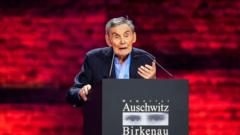
Polish Holocaust survivor, esteemed historian, and journalist Marian Turski has passed away at 98 years old, leaving a legacy that urges humanity to confront its past. Born as Moshe Turbowicz in 1926 in Lodz, Poland, Turski endured the harrowing realities of the Lodz Ghetto, Auschwitz-Birkenau extermination camp, and perilous death marches during his adolescence.After the war, Turski dedicated his life to education and journalism, becoming a foundational figure in Poland's Jewish history by co-founding the Museum of the History of Polish Jews in Warsaw. He served as president of the International Auschwitz Committee and gained international prominence during a heartfelt address at the 75th anniversary of Auschwitz's liberation in 2020, warning that "Auschwitz did not fall from the sky," urging vigilance against the seeds of hatred that can lead to such atrocities.Turski's childhood was marred by the brutal Nazi invasion. Following Poland's conquest in 1940, he and his family were confined to the oppressive Lodz Ghetto, where they faced disease and starvation. His harrowing journey through Auschwitz began in 1944 after his family was forcibly separated, with his father and brother tragically killed in the gas chambers, while his mother was sent to a different camp. In January 1945, as Soviet forces advanced, Turski was among tens of thousands forced into death marches across Europe, forced to walk vast distances in freezing conditions before landing in Terezin, where he narrowly escaped death from hunger and illness.Despite offers for a new life elsewhere, Turski chose to return to Poland, embodying hopes of rebuilding a socialist nation. He pursued history at the University of Wrocław, transitioning into a prominent journalist role at Polityka magazine, where he continued to weave history into contemporary discussions.His poignant reflections are timeless; at the 80th anniversary of Auschwitz in January, he cautioned against rising antisemitism, linking it to the horrors of the Holocaust and advocating for awareness and action rather than indifference. He encapsulated this ethos in the reimagined Eleventh Commandment, “thou shalt not be indifferent,” emphasizing that indifference can lead to future tragedies.His passing has elicited heartfelt tributes, including from Poland's chief rabbi and prime minister, who acknowledged Turski’s indelible impact on contemporary society and moral discourse. His voice will resonate through generations, reminding us that the lessons of history must not be forgotten.