In brief
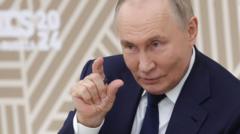
In an effort to counter Western isolation, Russia's President Vladimir Putin is hosting a significant Brics summit in Kazan with leaders from over 20 nations, including China and India. The gathering is designed to project unity among non-Western allies and explore alternatives to the U.S. dollar for international trade, while underlying tensions within the group could challenge their collective goals.
In a bold display against Western sanctions, Russian President Vladimir Putin is set to welcome more than 20 heads of state at the Brics summit in Kazan, marking what the Kremlin describes as one of its "largest-scale foreign policy events ever." Leaders from key countries, including China's Xi Jinping, Indian Prime Minister Narendra Modi, and Iranian President Masoud Pezeshkian, will gather to signal that the West’s attempts to isolate Russia are failing, according to political analysts.Chris Weafer, a founding partner at Macro-Advisory, stated that this summit serves to demonstrate that clamping sanctions do not seem to deter Russia. The Brics alliance, comprising Brazil, Russia, India, China, and South Africa, has grown to include nations like Egypt, Ethiopia, Iran, and the United Arab Emirates, collectively representing approximately 45% of the global population and nearly 28% of the world's economy.The summit must navigate the delicate dynamics within Brics, as citizens in these nations may hold different views on collaboration against Western dominance. Moscow's objectives primarily revolve around promoting alternative trade solutions to bypass U.S. Dollar reliance, emphasizing calls for Brics nations to establish an autonomous cross-border payment mechanism without Western currencies.Despite the camaraderie projected, significant disparities exist among members. Expert Jim O'Neill underscores that the cooperative spirit of Brics is clouded by tensions—especially between heavyweights China and India—as well as newer additions like Egypt and Ethiopia that have their own historical disputes. O'Neill reflects on the improbability of achieving a unified consensus on substantial policies given the friction among member economies.While Russia promotes an anti-Western narrative advocating for a "new world order," India and other Brics participants remain inclined towards maintaining ties with Western powers. As the summit progresses, Putin's challenge lies in masking these internal rifts with a façade of solidarity while asserting that Russia's global stature remains intact in light of growing geopolitical shifts.