In brief
President Trump addressed the elite gathering at Davos with a striking ultimatum regarding tariffs and global trade, prompting both concern and cautious optimism among world leaders as they navigate the new dynamics of international relations and economic policies.
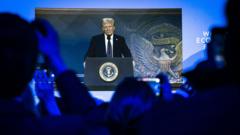
In a rare intersection of political bravado and economic strategy, President Donald Trump delivered a provocative message to global leaders during the annual World Economic Forum held in Davos, Switzerland. As attendees from various nations, including officials, industry giants, and celebrities gathered in the alpine locale, Trump’s virtual appearance sent shockwaves through the assembly, underlying his administration's "America First" policy.“Nothing will stand in our way,” Trump proclaimed, hinting at a potential overhaul of international trade relations. His admonition for companies to relocate production to the U.S. to avoid exorbitant tariffs was both bold and alarming, encapsulated by his pointed suggestion that Canada could even become a U.S. state to escape penalty fees. This statement drew gasps from the audience, highlighting the potentially dramatic shifts in international economic ties.Amidst the glare of his ambitious claims about the U.S. economy and technological advancements, Trump’s remarks oozed charm yet threatened to disrupt the fragile international economic order. Observers noted a blend of admiration and anxiety as participants navigated the implications of his words—can Trump's vision genuinely reshape trade dynamics, or will it destabilize the existing system?Trump's agenda appears clear: diminish energy costs through negotiations with oil-producing nations, and leverage this as a means to undercut adversary states such as Russia while stabilizing inflation domestically. His administration’s newfound leverage in the Middle East following a ceasefire showcases the geopolitical alliances influencing his trajectory.However, the reception to Trump's bold economic assertions was mixed. High-profile CEOs expressed apprehension over retaliatory tariffs on U.S. exports, while others speculated whether the allure of a rising stock market might temper his aggressive tariff strategies. The underlying sentiment suggested a massive geopolitical chess game where the stakes include both tariffs and a potential backlash against U.S. dominance.As Trump stirs the pot with threats of withdrawing from institutions like the IMF and the World Bank, European officials voiced a desire for cooperative dialogue to prevent an escalation of trade conflicts. Canada has already begun strategizing retaliatory measures, while UK and EU leaders stand resolute against unwarranted tariffs.With global trade uniquely poised on a precipice, the urgency of collaboration among G7 and NATO allies is underscored. Amid this uncertainty, key tech figures at Davos acknowledged the competitive advantage of the U.S. over Europe, yet fears of mindfully redirecting talent toward more politically stable environments loom large in the backdrop.As calls for cohesive action emerge, the collective response from other nations against Trump's unfettered economic policies remains critical. The unfolding narrative at Davos highlights a world caught between adaptation and resistance as the climate of global trade continues to evolve under Trump’s influence. The effects of this week’s gathering will resonate far beyond the Swiss Alps, signaling a pivotal moment in international economics and geopolitics.