
In brief
Following a contentious phone call with President-elect Donald Trump, Mexico's President Claudia Sheinbaum clarifies her government's position on migration and threatens retaliatory tariffs against the US. As concerns grow about potential trade conflicts, both leaders grapple with the underlying migrant crisis and its implications for future relations.
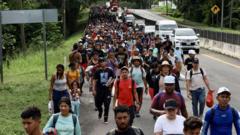
Mexican President Claudia Sheinbaum is clarifying her government’s position regarding immigration to the US, following a phone call with President-elect Donald Trump that ignited tensions between the two nations. After their conversation, Trump claimed on social media that Sheinbaum had agreed to halt migration through Mexico in an effort to effectively close the southern border. However, Sheinbaum responded swiftly, stating firmly that Mexico does not intend to close its borders. Instead, she emphasized the need to address migration while respecting human rights and urged collaboration over isolation. “We reiterated that Mexico's position is not to close borders but to build bridges between governments and peoples,” she affirmed on social media.Concerns are heightened due to Trump’s announcement of a possible tariff campaign, where he indicated plans to impose a 25% tariff on Mexican and Canadian goods and a 10% tariff on imports from China unless illegal immigration and drug trafficking cease. Sheinbaum remarked that Mexico would retaliate with its tariffs if the US pursued this financial route, calling it "a shot in the foot," alluding to the potential violation of the USMCA trade agreement forged during Trump's first presidency. Economy Minister Marcelo Ebrard joined Sheinbaum in calling for enhanced regional cooperation to mitigate the harmful effects of such tariffs, as Canadian Prime Minister Justin Trudeau convened with provincial leaders to strategize a unified response. During her initial remarks about the Trump conversation, Sheinbaum indicated that the two leaders had an “excellent conversation,” emphasizing that migrant caravans were being managed within Mexico, thus preventing them from reaching the northern border. Nevertheless, remarks from Trump later suggested a misunderstanding of the agreements, with his assertion that Mexico would cease migration to the US “immediately.”As the political landscape shifts with Trump’s return, the situation surrounding undocumented migrants remains complex. With the US presidential election influencing immigration policies, and under increasing diplomatic pressure, Mexico is facing unprecedented levels of migrant suppression, inadvertently leading many migrants to request voluntary deportation due to the harsh conditions. Trump will assume office with an immigration issue that has seen fewer apprehensions at the US-Mexico border than in recent years, setting the stage for potential new policies amid ongoing trade and migration disputes.

