
In brief
Former President Trump’s claims about China "operating" the Panama Canal have sparked controversy, but official statements clarify that the canal is managed by the Panamanian government. This article explores Beijing’s significant economic presence in Panama and its implications for U.S.-China relations.
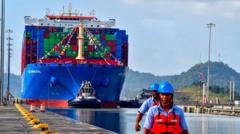
The Panama Canal, a vital maritime passage cutting through Central America, has returned to the spotlight amidst political rhetoric from former President Donald Trump. During his inaugural address, Trump asserted, “China is operating the Panama Canal,” a claim met with swift denials from both Panamanian and Chinese officials.The Panama Canal, stretching 51 miles (82 km), facilitates significant global maritime trade, with approximately 14,000 ships navigating it annually. Trump’s remarks echo prior comments made on social media, where he described Chinese control of the canal as “lovingly, but illegally,” a notion that Panamanian leaders have categorically rejected.Responding to Trump’s claims, Panamanian President José Raúl Mulino emphasized, “There is absolutely no Chinese interference” in the canal’s operations, which are managed by the Panama Canal Authority, a governmental entity. Despite his assertions, Trump’s concerns highlight deeper anxieties among U.S. officials regarding China's growing investments in canal-adjacent infrastructure.The historical context is crucial: Initially constructed between 1904 and 1914 under U.S. supervision, the canal remained under American control until the implementation of treaties in 1977, which began a transfer of authority to Panama finalized in 1999. This means the canal is neutral territory, with the U.S. retaining the right to defend its neutrality against external threats.While China does not govern the canal, its presence is notable. For the period from October 2023 to September 2024, Chinese cargo accounted for 21.4% of canal traffic, designating it as the second-largest user after the United States. Moreover, Chinese firms, including Hutchison Port Holdings, manage critical ports adjacent to the canal, raising concerns in Washington about potential strategic leverage.Experts note that these investments do not equate to ownership but are indicative of rising geopolitical tensions between the U.S. and China. Additionally, China has invested billions in infrastructure in Panama, reinforcing its influence in a region traditionally dominated by American interests. The relationship between Panama and China became more solidified in 2017 when Panama established diplomatic relations with Beijing, leading to its participation in the Belt and Road Initiative—a strategy for global investment and development established by China.Panama’s strategic location continues to attract Chinese investment, including projects like a new cruise terminal and enhanced transport links across the canal area. These developments further complicate the narrative surrounding U.S. influence in the region and emphasize the growing mutual interests between Panama and China.In summary, while Trump’s assertion regarding Chinese control of the Panama Canal has been emphatically denied by Panamanian authorities, the reality of Chinese economic influence in Panama signals a shift in the region’s geopolitical landscape. Understanding this dynamic is fundamental to grasping the evolving nature of international relations in a climate increasingly dominated by economic competition.

