In brief
During a recent press briefing, former President Trump incorrectly asserted that Ukraine is to blame for the ongoing war with Russia and made misleading statements about President Zelensky's approval ratings and electoral legitimacy. These claims were met with condemnation from Zelensky, who accused Trump of perpetuating Russian disinformation.
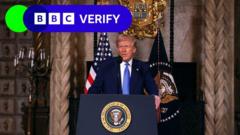
In a recent press conference held at his Mar-a-Lago estate, former President Donald Trump made a series of controversial claims regarding Ukraine, casting doubt on President Volodymyr Zelensky's legitimacy while seeming to echo Russian rhetoric about the ongoing conflict. As discussions occurred between U.S. officials and a Russian delegation in Riyadh aimed at ending the war, Trump's statements underscored the contentious nature of current U.S. political discourse surrounding the situation in Ukraine.Trump characterized Zelensky as a "dictator without elections," highlighting that Ukraine has not held a presidential election since 2019. He contended this as evidence of Zelensky's unfitness for leadership, failing to mention the martial law enacted following Russia's invasion in February 2022, which has suspended electoral processes. This martial law had been established long before, in response to Russia's annexation of Crimea in 2014, and elections were declared challenging amid the continued conflict.The Ukrainian president responded to Trump's remarks, suggesting that the former president is trapped in a "disinformation space" manipulated by Russia. BBC Verify undertook a detailed fact-check of Trump's assertions, questioning his claim that Zelensky possesses a mere 4% approval rating, a statistic unsupported by reputable polling data. Conversely, some surveys indicate that around 57% of Ukrainians currently express trust in Zelensky, despite a noted decline from prior months.In his comments, Trump sought to clarify that Ukraine had ample opportunity to end the conflict but implied they bore responsibility for instigating it—claims that align with longstanding narratives pushed by the Kremlin. He stated, "You should have never started it," reflecting ideas often presented by Russian President Vladimir Putin, who has insisted that Ukraine initiated hostilities. Historical context reveals that the current war is a continuation of a broader conflict initiated by Russia's aggressive actions in 2014.As misunderstandings and exaggerated claims about Ukraine's political stability persist, it becomes increasingly vital for public figures to approach the discourse around this crisis with diligence and clarity. The ongoing war has deeply affected millions, with significant consequences hinging upon accurate information and responsible discourse in the global arena. Zelensky’s commitment to hold elections post-conflict highlights the complexity of Ukraine's governance amid war, emphasizing the need for understanding over misrepresentation in these heated discussions.