Spanish Prime Minister Pedro Sanchez has promised to get to the bottom of why two high-speed trains collided in southern Spain, killing at least 40 people, as rescuers continue to search the wreckage.
After visiting the site of the crash, Sanchez also announced three days of national mourning for the victims.
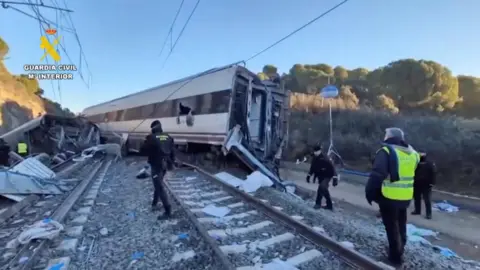
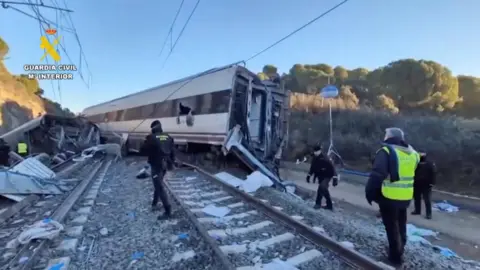
More than 120 additional individuals were injured when carriages on a train headed for Madrid derailed and collided with another train in Adamuz on Sunday evening, leading to the worst rail disaster in Spain in over a decade.
The rail network operator Adif reported that the collision transpired at 19:45 local time on Sunday, roughly an hour after one of the trains departed from Málaga en route to Madrid. At the time of the accident, it derailed on a straight track near Cordoba.
The impact caused the carriages of the second train, traveling south from Madrid to Huelva, to crash into an embankment. The majority of fatalities and injuries occurred in the front carriages of that train.
Rescue teams reported that the twisted wreckage created significant challenges for recovering individuals trapped inside the cars.
Sanchez stated, This is a day of sorrow for all of Spain, for our entire country. We are going to get to the truth, we are going to find the answer, and when that answer about the origin and cause of this tragedy is known, we will make it public with absolute transparency and clarity.
Transport Minister Óscar Puente remarked that an investigation could take at least a month, deeming the incident extremely strange.
According to initial findings from a source familiar with the investigation, a faulty joint on the rails was identified, potentially widening the gap between rail segments as trains passed. However, it remains unclear whether this fault contributed to or resulted from the crash.
The type of train involved, the Freccia 1000, can reach speeds of 400 km/h (250 mph), highlighting the dire implications of such a collision. Emergency services are treating numerous survivors, with some still in intensive care as efforts continue to identify the deceased.
In the wake of the incident, King Felipe VI and Queen Letizia expressed their condolences, and emergency agencies have urged survivors to reach out to their families amid widespread agony and uncertainty.
The Spanish Red Cross has also dispatched support services and counseling for relatives nearby, emphasizing the distress caused by the lack of information.
This incident marks another tragedy in Spain's rail history, echoing the 2013 derailment in Galicia that resulted in 80 casualties. Spain's high-speed rail network, the second-largest in the world, connects over 50 cities and spans more than 4,000 km.