In brief
Scientists leverage X-ray imaging and AI to restore ancient knowledge, revitalizing connections to the past.
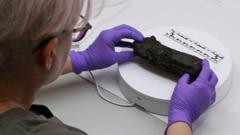
In a groundbreaking development, researchers have unveiled the first glimpse of text hidden within a carbonized scroll from Herculaneum, thanks to advanced X-ray imaging and artificial intelligence (AI) methods that do not damage the fragile remains. This unprecedented access to the scroll, which has lain dormant since the devastating eruption of Mount Vesuvius in 79 AD, marks a significant milestone in the study of ancient manuscripts.The scroll, reduced to a charred mass resembling charcoal, was among hundreds of other carbonized scrolls discovered in Herculaneum, a town once buried under volcanic ash alongside Pompeii. For years deemed unreadable, experts believed the delicate papyrus could crumble if physically handled. However, the innovative approach led by the Vesuvius Challenge has rekindled hopes of deciphering its rich content, believed to pertain to philosophy.Under the stewardship of the Bodleian Library at the University of Oxford, a collaborative team of scientists collected the scroll and transported it to the Diamond Light Source facility in Oxfordshire. Utilizing high-energy synchrotron X-rays, the researchers were able to scan the scroll without risk of damage. The state-of-the-art scans yield a detailed 3D reconstruction, revealing the layers of the papyrus and enabling careful analysis of its structure.Stephen Parsons, the project lead, underscored the excitement within the team, noting that while the manuscript's text is not yet fully legible, definitive letters have begun to emerge. "We're confident that we can ultimately read significant portions of the scroll," he remarked, expressing optimism based on previous successes with other Herculaneum texts.The decoding process involves distinguishing the ancient ink from the carbonized papyrus, as both materials share similar properties. The AI system's ability to detect subtle differences in composition will be pivotal to unveiling letters and phrases. What remains to be seen is whether the newly revealed text reflects Greek Epicurean philosophy, as speculated based on prior analyses of similar scrolls.Nicole Gilroy, head of book conservation at the Bodleian Library, emphasized the project’s emotional resonance: "There's a real human aspect to it that I just think is really precious," she said, highlighting the connections that this research rekindles between modern society and ancient thinkers.As researchers fine-tune their techniques and continue their efforts to identify and articulate the lost philosophies captured in the scrolls, the project serves as a beacon of hope for merging modern innovation with timeless wisdom, illustrating the potential for technology to resurrect knowledge from the ashes of history.