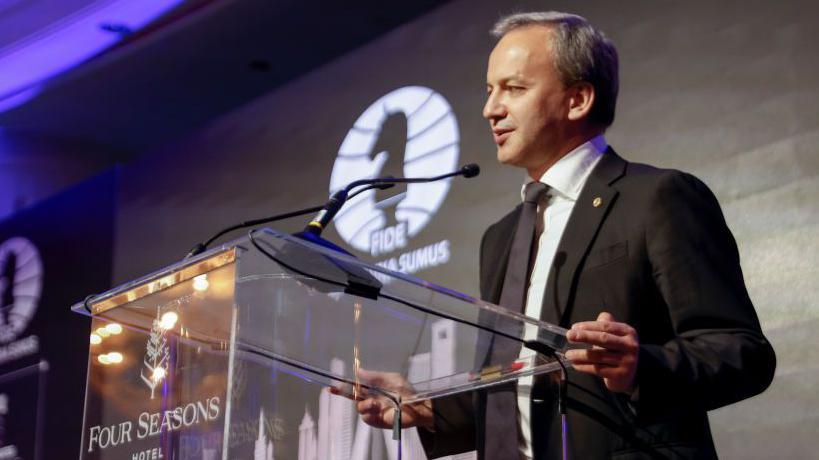
After the European Union added former Russian deputy prime minister Arkady Dvorkovich to its sanctions list, the International Chess Federation has been plunged into turmoil. Dvorkovich has announced that he will voluntarily suspend his powers following the travel ban and asset freeze.
The sanctions were justified by the EU on the basis of his publicly supporting the annexation of Crimea and referring to occupied Ukrainian cities as new territories of the Russian Federation. He did not resign, but said the restrictions prevent him from serving in his role.
Ukraine has hailed the move as an important victory. In a statement, Volodymyr Kovalchuk, first vice president of the Ukrainian Chess Federation, noted that people who form sports structures in favor of an aggressor state have no place in senior international positions.
Malcolm Pein, representing England, described the sanction as “an earthquake and a massive diplomatic victory for Ukraine.” He added that it could reduce Russia’s influence in chess, a soft‑power tool used by the former Soviet Union since World War Two.
Dvorkovich’s tenure began in 2018 and continued through the 2022 re‑election. During his reign, Russian national teams were banned from international competition following the war in Ukraine. Critics say Moscow intensified its control of the federation by altering internal rules and pressuring votes in favour of Russia—a point disputed by Dvorkovich who highlighted the federation’s diverse regional representation from Switzerland, India, Norway, Latvia, the United States, Italy, France and beyond.
The future leadership of FIDE remains uncertain as the organization seeks to balance its global membership with the geopolitical realities shaped by the conflict in Ukraine. Chess, a sport celebrated for promoting strategic thinking, now faces a period of transition that could reshape its governance and international roles.