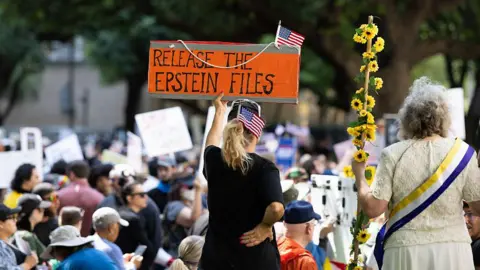
The US Department of Justice (DOJ) has removed thousands of documents related to Jeffrey Epstein from its website after victims said their identities had been compromised.
Lawyers for Epstein's victims said flawed redactions in the files released on Friday had 'turned upside down' the lives of nearly 100 survivors.
Email addresses and nude photos in which the names and faces of potential victims could be identified were included in the release.
Survivors issued a statement calling the disclosure 'outrageous' and said they should not be 'named, scrutinized and retraumatized'.
The DOJ said it had taken down all the flagged files, stating that mistakes were due to 'technical or human error'.
In a letter submitted to a federal judge on Monday, the DOJ stated: All documents requested by victims or counsel to be removed by yesterday evening have been removed for further redaction.
The department is also examining new requests and checking for any additional documents requiring redaction. A 'substantial number' of independently identified documents have also been removed.
The release, mandated after Congressional approval, required the federal government to redact identifying details of victims.
On Friday, two lawyers representing victims asked a federal judge in New York to order the DOJ to take down the website hosting the files, calling the release 'the single most egregious violation of victim privacy in one day in United States history'.
Victim advocates have voiced concerns over the implications of the breach, with one survivor describing it as 'life-threatening' after personal information was published.
Many victims are dissatisfied with the outcome of the release, claiming that the DOJ has violated their privacy agreement by failing to properly redact documents. The fallout continues to raise questions about the DOJ's handling of sensitive information.
Gloria Allred, a lawyer representing many victims, previously commented that the latest release had disclosed names of numerous victims, some of whom had not been publicly identified before.
A spokesperson for the DOJ reiterated a commitment to protecting victim privacy and is working to rectify the issues, citing that only 0.1% of released pages contained unredacted information.
Millions of files relating to Epstein have been released by the DOJ since a law mandated their release last year, including three million pages, 180,000 images and 2,000 videos last Friday.
Epstein died in a New York prison cell on 10 August 2019 while awaiting trial on sex trafficking charges.