In brief
Mauricio Hoyos, a seasoned marine biologist, survived a shark attack while researching in Costa Rica. Despite the near-fatal encounter, he expresses a desire to meet the shark again, viewing the incident as a testament to the creature's vital role in marine ecosystems and his own resilience.
Mauricio Hoyos still remembers the pressure that the jaws of a female Galapagos shark, over 3m (10ft) in length, exerted on his skull.
The animal had lunged at him with astonishing speed, giving him barely enough time to duck his head in a last ditch effort to protect his jugular vein.
When it closed its jaw, I felt the pressure of the bite, and then, after what I think was a second, it opened it again and it let me go, Hoyos told BBC Mundo from his home in Baja California, Mexico, a little over month after surviving the incident.
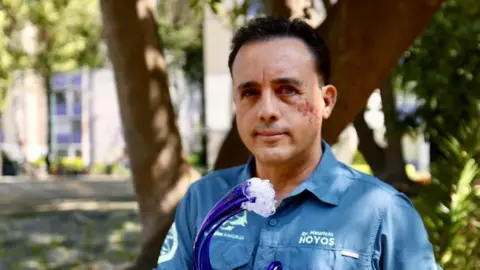
Hoyos, a marine biologist with over 30 years of experience studying sharks in their natural habitat, was on a research trip in Costa Rica when he was attacked by the shark in September.
Less than two months on, and still bearing the scars from the attack on his face, he describes his recovery as incredible - and says he even hopes to encounter his assailant again.
For Hoyos, what happened to him that day in the waters off Cocos Island is the result of normal animal behaviour when confronted with a perceived threat.
In this case, this bite was like a dog's, he says.
Hoyos was alerted to the shark's presence in the water by tourists. It was at a depth of 40m, and he told the captain of the boat he was on that he would be there for a maximum of five minutes.
As he began his slow descent, he recalls the shark swimming towards him. Instead of fleeing, this particular shark reacted differently, staring at him instead.
I saw her little eye looking at me, and I saw her very calmly turning around, he explains.
But suddenly, the shark lunged at him. I lowered my head, and what I felt was its lower jaw digging into my cheek and its upper jaw into my head. I was there, I imagine for a second, no more, inside its jaw, and then it simply opened it again.
Hoyos had to act quickly, swimming to the surface while managing his heavy bleeding and loss of visibility. Despite sustaining serious injuries, he demonstrated remarkable resilience, relying on his extensive diving training to survive the ordeal.
After reaching the surface, he was rescued and received timely medical attention that prevented infection and facilitated a swift recovery. Hoyos was able to return to the water soon after, planning further dives in the same region where the attack occurred.
In a reflective mood, Hoyos emphasizes the importance of sharks in marine ecosystems and hopes to advocate for their conservation, driven by the experience of his own near-death encounter.