
In brief
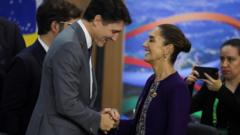
As Donald Trump prepares for a second term, relations between Canada and Mexico are strained by his tariff threats. Canadian officials attempt to separate their border issues from Mexico's, while Mexico's President, Claudia Sheinbaum, asserts her nation's rights in the face of these provocations. Trade dynamics are increasingly scrutinized, highlighting the need for cohesive strategies among North American nations.
As tensions escalate ahead of President-elect Donald Trump’s second term, both Canada and Mexico are feeling the repercussions of his recent warning regarding tariffs. Trump has threatened a blanket 25% tariff on their imports unless both nations tighten border security with the United States. In response, Canadian officials quickly distanced their border issues from Mexico’s, emphasizing a disparity in drug smuggling and unlawful crossings. Canada's stance has stirred controversy in Mexico, with Mexican President Claudia Sheinbaum expressing her nation's need for respect from its trading partners. Sheinbaum noted that Canada deals with its own social issues, thus calling for recognition of the cultural wealth Mexico possesses.The friction was further aggravated when Canada’s US ambassador relayed Trudeau’s point that the northern border is markedly different from that of Mexico. Ontario Premier Doug Ford denounced any attempt to lump the two nations together on border security as "insulting," reflecting the longstanding regulatory differences and unique challenges faced at each border.As Canadian officials advocate for a unified front with the US against China, concerns persist regarding Chinese interests in Mexico—labeled as a trade backdoor. Canada recently imposed 100% tariffs on electric vehicles from China, with plans for similar duties on steel and aluminum, while Mexico refrained from implementing significant tariffs.While all three countries currently operate under a North American trade agreement set to be renegotiated in 2026, Ontario’s trade reliance on the US—surpassing C$493bn ($350bn) in 2023—adds urgency to these negotiations. Ford's call for separate bilateral agreements has gained traction among other Canadian leaders, raising questions about the strength of trilateral unity in the wake of Trump's tariff threats.Trade negotiator Gutierrez Romano criticized Canada’s divided approach, stating that unity against the US is irrational. Mexican public sentiment echoed this strain, with scholars suggesting a significant deterioration in the relationship, which had flourished for over 85 years. Sheinbaum, newly in office, is advocating for Mexico’s rights as a practical and equal partner in North America. Sheinbaum aims to navigate relations responsibly, emphasizing human rights in her immigration strategy while engaging with Trump on mutual concerns.Data indicates a stark difference in illegal crossings and drug seizures, with the northern border showcasing much lower numbers compared to the southern border. Nonetheless, in the wake of Trump’s threats, Canada pledges to enhance border security, while Mexico, asserting its approach focuses on building bridges rather than closing borders, showcases its own border management improvements.Collectively, Canada, Mexico, and the US navigate complex trade dynamics that underpin a vital part of the American economy, with ongoing negotiations poised to shape future relations among the three North American nations amidst rising geopolitical challenges.

