
In brief
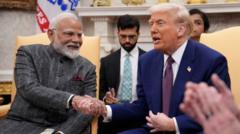
US President Donald Trump and Indian Prime Minister Narendra Modi discuss trade, tariffs, and bilateral relations during a pivotal meeting aimed at fostering economic cooperation.
US President Donald Trump welcomed Indian Prime Minister Narendra Modi to the White House for crucial discussions on trade amidst escalating tensions over tariffs. Modi’s two-day visit comes as Trump has mandated reciprocal tariffs, meaning that US partners will now face import taxes that mirror those imposed by other nations on American goods.The agenda for the meeting is heavily focused on trade and immigration issues. Trump is likely to press Modi to facilitate the return of undocumented immigrants to India. Modi, who communicated his excitement about the talks via social media ahead of the meeting, also mentioned having discussions related to space and technology with influential entrepreneur Elon Musk.Reflecting on their ongoing relationship, Trump remarked on their strong rapport, declaring, “We've had a wonderful relationship.” Modi chimed in, asserting his belief that their partnership will advance at an accelerated pace, claiming, “I firmly believe with Trump we will work with twice the speed we did in his first term.”Trump emphasized India's expected increased purchases of US oil and gas, highlighting a significant aspect of the bilateral economic relationship. However, he has also ordered his advisers to prepare for broad new tariffs on US trading partners, set to possibly take effect by April 1. This move is part of Trump's overarching promise to rectify what he perceives as an unfair trading system that has historically disadvantaged the US.In a press conference within the Oval Office, Trump asserted that the US's allies impose higher taxes on imports compared to its adversaries. He pointed out the disparity in tariff rates, specifically criticizing India's 39% average applied tariff rate on agricultural goods, contrasted with the US's mere 5%. He also noted the stark difference in tariffs on motorcycles, where India levies a staggering 100% while the US charges just 2.4%.Although there are concerns that these tariffs might result in higher consumer prices, Trump maintained that the long-term benefits would outweigh short-term costs, asserting, "Prices could go up somewhat, short-term, but prices will also go down." He envisions a future where American manufacturing thrives and new jobs are created as a result of these trade policies.In the wake of these ongoing tariff discussions, Trump has already applied a 10% tax on imports from China, citing manufacturing practices related to the fentanyl crisis. He has also rafted tariffs aimed at Canada and Mexico, reinforcing the administration's tough stance on trade as it seeks to negotiate more favorable terms for American businesses.


